The churches at a glance
| Church | Where | From the bus 60 terminus |
|---|---|---|
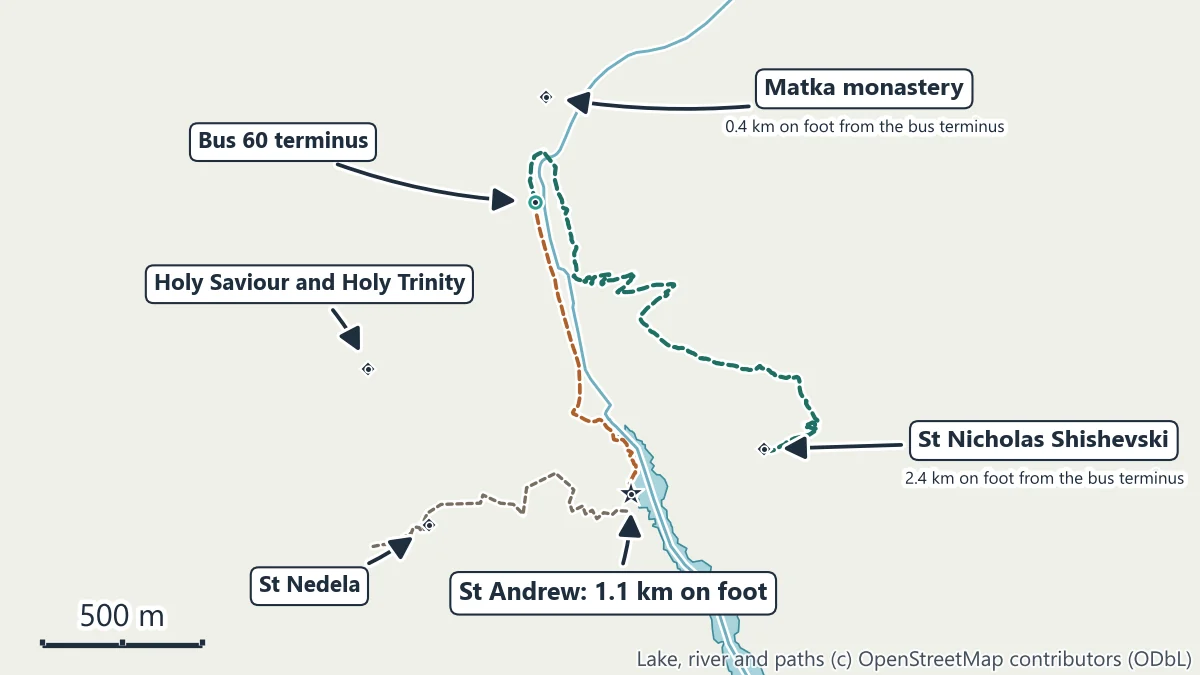
| St Andrew | on the shore beside the dam | 1.1 km on foot |
| Matka monastery (Dormition of the Mother of God) | by the river below the dam | 0.4 km on foot |
| St Nicholas Shishevski | on a terrace above the right bank | 2.4 km on foot |
| St Nedela | high on the slope above St Andrew | steep path from St Andrew, about 0.9 km |
| Holy Saviour and Holy Trinity | on the slope above St Andrew | paths from St Andrew |
Walking figures are routed along the mapped path network from the bus terminus; the St Nedela figure is the length of the mapped path.
St Andrew
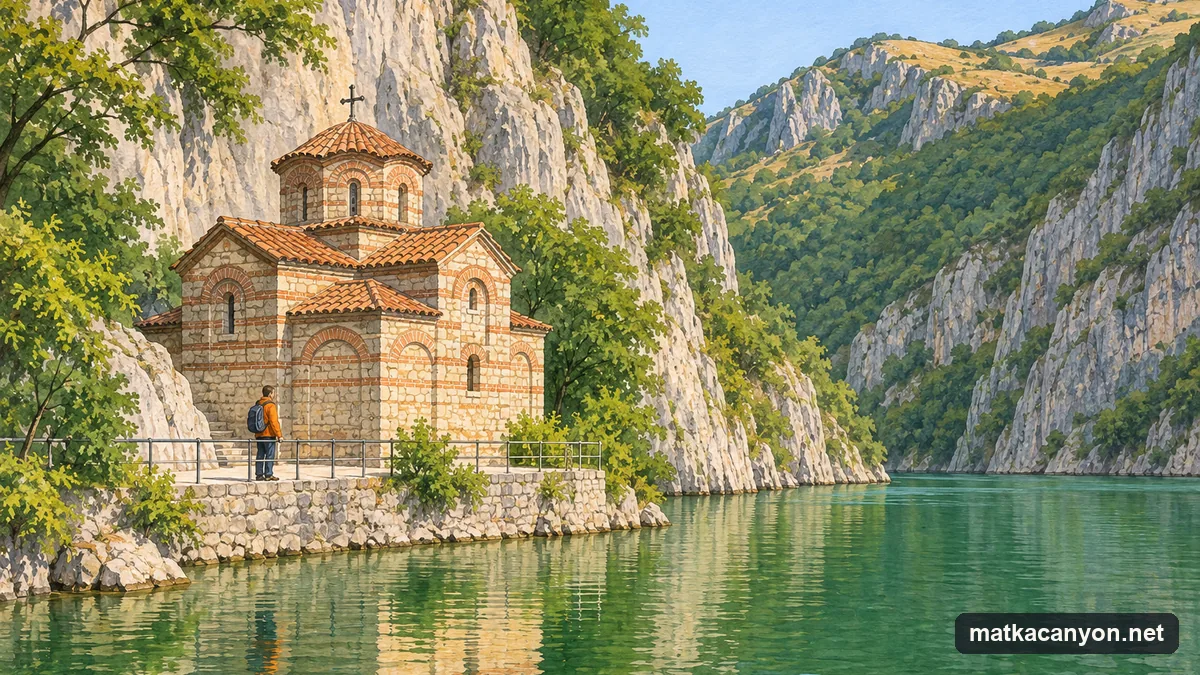
The church of St Andrew was built in 1388-1389, in the years of the Battle of Kosovo (1389) and before the Ottoman conquest of Skopje in 1392. Its founder was Andreaš, the second son of King Volkašin and Queen Elena and brother of King Marko, whose land this was; the founder’s inscription is above the west door. The church stands on a terrace on the left bank, which before the dam was high above the river.
Its plan is a free cross with a dome, one of the few churches of that shape preserved in the country. The paintings inside are in three zones: the great feasts under the dome, the Passion of Christ below them and, at the bottom, full-length saints and warrior saints, which the painters gave pride of place. In the apse the Mother of God sits enthroned with Christ. North of the altar apse an inscription names the painters: the Metropolitan Jovan, a painter known from churches around Prilep, and the monk Grigorije. A narthex was added in the middle of the 16th century and painted in 1559-1560. In 2018 the state’s office for the protection of cultural heritage declared the monastery cultural heritage of particular importance.
The Matka monastery
Below the dam, on a level terrace on the left bank where the gorge opens, stands the monastery that gave the place its name: the Matka monastery, with its church of the Dormition of the Mother of God. The monastery’s own history gives the church a 14th-century origin: some researchers date it to about 1337, and a tombstone of 1372 built into the church shows it stood by then. The roof and the frescoes are of the late 15th century, painted in the manner of the Ohrid school; a narthex added by a woman named Milica in 1497 has not survived. It is a working monastery, 0.4 km on foot from the bus 60 terminus.
St Nicholas Shishevski
On a terrace high above the right bank of the lake, facing St Andrew, stands the monastery of St Nicholas, named after the nearby village of Shishevo. No road reaches it: you walk. The path from the bridge near the Matka monastery measures 2.4 km on foot from the bus 60 terminus and climbs steeply; other paths come from Shishevo and over Mount Vodno. The ban on the Matka path of 26 February 2026 does not list which mountain paths it covers, so check the signs where the path starts. The church was built or renewed in 1345 by a priest named Nenad and others, and was enlarged in the 17th century.
St Nedela, Holy Saviour and Holy Trinity
Above St Andrew, on the slope of the left bank, are the churches of Holy Saviour and Holy Trinity, and higher still, on a ridge over the canyon, the small church of St Nedela, with a view across to St Nicholas. A steep mountain path of about 0.9 km climbs to St Nedela from beside St Andrew. Take it only in dry weather and in proper shoes. Since 26 February 2026 the lakeside path from St Andrew has been closed for falling rock, and the notices of the ban do not list which mountain paths it covers; check the signs at St Andrew before you climb.
Visiting
- Dress and behaviour: these are churches and monasteries in use. Cover shoulders and knees, keep your voice down and do not photograph services.
- Getting there: bus 60 to its last stop; see Skopje to Matka Canyon.
- Combining: the boats to Vrelo cave leave from the landing below St Andrew. The lakeside trail that starts there has been closed since 26 February 2026.
Official information
- Macedonian Orthodox Church, whose list of well-known monasteries includes St Andrew, St Nicholas of Shishevo and the Dormition at Matka.